
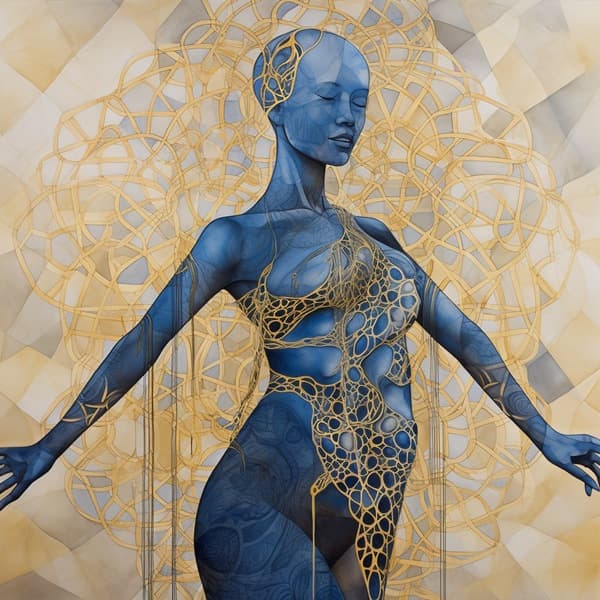
Composite Psyche Inconjunct Venus
The Unbridged Intimacy

Psyche inconjunct Venus in a composite chart names a relationship organized around a gap that will not close. One person's need for psychological depth—for being known in the specific, sometimes difficult textures of their inner life—does not fit neatly into the other's relational style. Venus wants harmony, reciprocal pleasure, the ease of being liked. Psyche wants to be seen, to have the darker or more complex parts of consciousness witnessed and held. The inconjunct produces a recurring low-level friction: neither person is quite wrong, but neither can fully satisfy the other's primary relational hunger without something else getting sacrificed.
The relationship may feel like it oscillates between two states that neither person controls. One moment there is genuine intimacy—a conversation that lands, a vulnerability that is met—and the next, one partner retreats into surface pleasantness or the other pushes too hard for depth and is met with withdrawal. This is not a failure to communicate better. It is the structure itself. One person may express love through steadiness, affection, the small rituals that make being together feel easy. The other may express love through witnessing, through asking the harder questions, through staying present to the parts of the partner that are not immediately likeable. When the depth-seeking partner reaches for real contact, the harmony-oriented partner may feel accused or burdened. When the harmony-oriented partner offers warmth, the depth-seeking partner may experience it as evasion. Over time, one or both people may stop trying to bridge the gap and simply manage around it—one person becoming the "lighter" one, the other the "serious" one, each reinforcing the other's role.
The cost of this pattern is that neither person gets to be whole inside the relationship. The depth-seeker learns to mute their need for psychological intimacy in order to preserve the connection's pleasantness. They may confide in others instead, or simply carry certain truths alone. The harmony-oriented partner learns to avoid the conversations that would deepen things, not out of cruelty but out of genuine discomfort with the intensity that depth requires. Both people may feel chronically misunderstood by the one person they most wanted to be understood by. The relationship becomes a place where the self is known, but not fully. The self is loved, but not in the way that touches the parts that most need witnessing.
The inconjunct does not ask for resolution. It asks for a different kind of honesty. Notice where the dynamic has assigned one person the role of "the emotional one" and the other "the practical one," and how that division protects both from having to hold complexity together. Notice whether the partners have stopped asking for what is actually needed because it has been decided it is not available here. The relationship's actual architecture is not a failure. It is a choice point that repeats: whether to keep reaching across the gap or to accept its permanent shape and grieve what that means.



























