Mercury Square Mercury
Thought Against Itself



"I embrace the clash of conflicting thoughts, for within lies the opportunity to expand my intellectual horizons and become a more effective communicator."
Mercury Square Mercury Opportunities
- Integrating opposing thoughts
- Embracing intellectual growth
Mercury Square Mercury Goals
- Balancing opposing thoughts
- Engaging in self-reflection
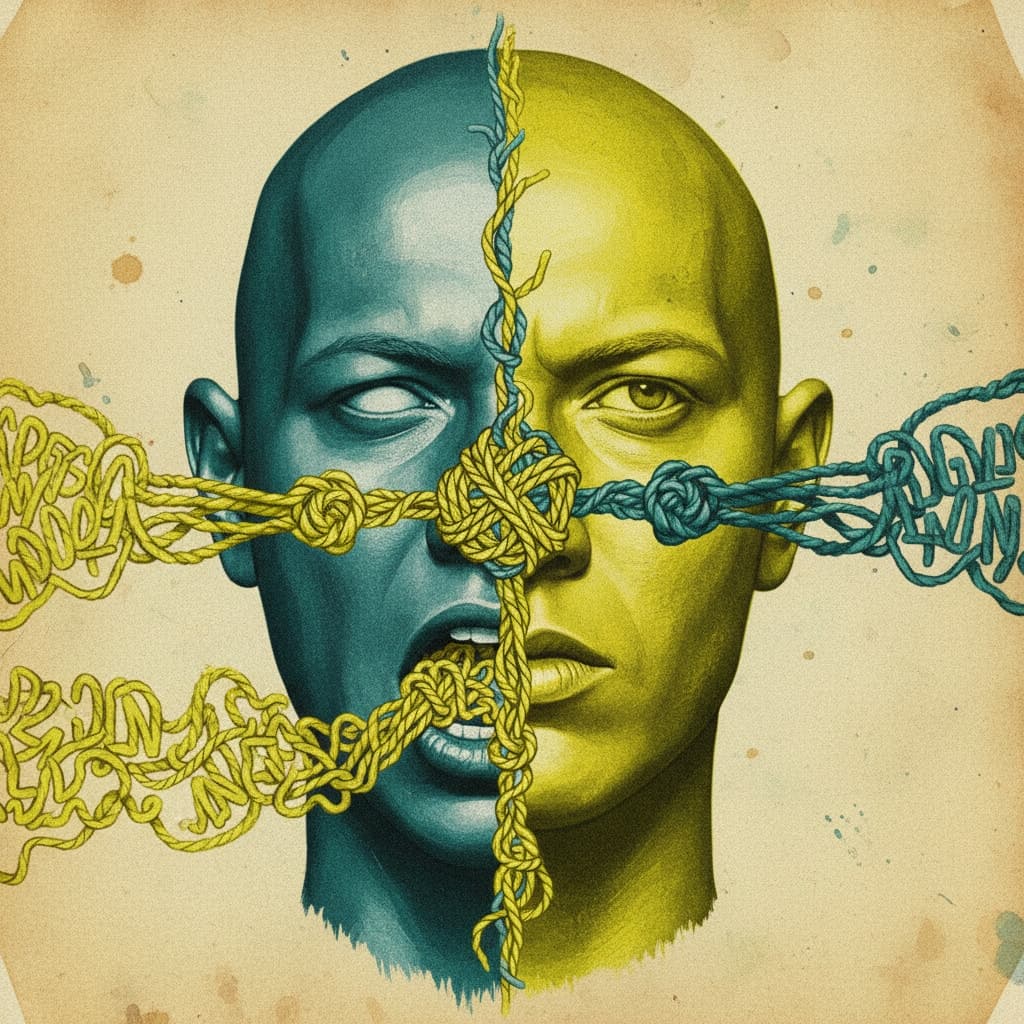
Mercury square Mercury is a rare internal collision, your mind arguing with itself in real time. This isn't fragmentation or confusion; it's your thinking process structured as tension. You have two different Mercury expressions operating simultaneously, and they don't naturally agree on how to process information, what to prioritize, or how fast to move.
What this produces in practice: you think in contradictions. You'll start articulating one position and mid-sentence feel the pull of an equally valid counter-argument. You gather data quickly, but the data refuses to settle into a single narrative. You spot the hole in any argument almost immediately, including your own. To others you may appear indecisive because you're not hesitating, you're genuinely holding multiple frames at once. You say something, then hear yourself say it, then already see the objection. You interrupt yourself. You change your mind not from weakness but from intellectual restlessness; the moment you've explained something one way, your mind is already testing the opposite. This can read as unreliability when it's actually your nervous system refusing to let any single perspective harden into dogma.
The real cost is momentum. You can talk yourself out of positions faster than you can commit to them. You may start projects that require sustained linear thinking, then abandon them because you've already mapped five alternative approaches. You keep revisiting what you just said. Certainty, even provisional certainty, feels like betrayal of the other side. This makes you exhausting to live with sometimes, because the conversation never quite closes. The tension is that conviction and intellectual honesty feel like opposites to you, when they're not.
What this friction is building toward is the capacity to hold complexity without collapsing it into false certainty. You cannot lie to yourself successfully because your own mind won't permit it. That internal argument is not a defect; it's a quality-control mechanism. When you stop fighting the contradiction and instead use it as a tool, when you learn to communicate the nuance you've actually lived, you become someone who can show others what they're missing, not someone who confirms what they already believe. Your gift is the ability to think past your own conclusions.