
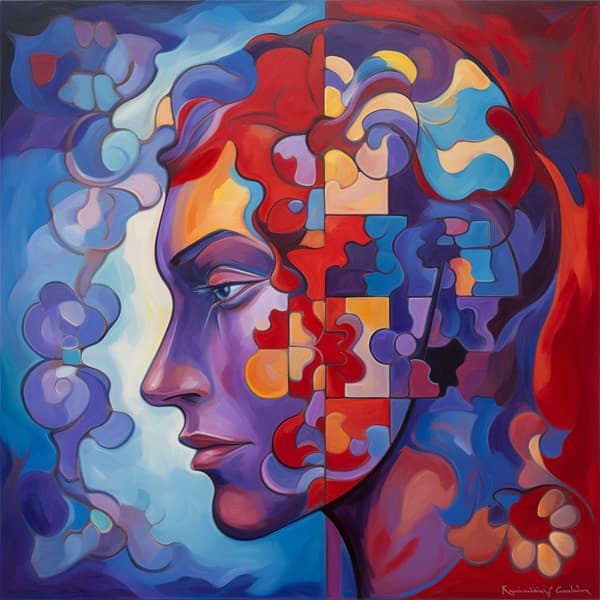
Pallas Inconjunct Moon
Feeling Meets Pattern



"I embrace the challenge of integrating my emotional wisdom and problem-solving abilities, allowing me to grow and become more self-aware."
Pallas Inconjunct Moon Opportunities
- Balancing emotions and rationality
- Integrating emotional intelligence and problem-solving
Pallas Inconjunct Moon Goals
- Emotional-Intellectual Integration
- Integrating self-awareness and growth
Pallas inconjunct Moon places you in a state of perpetual misalignment between how you feel and how you think. Your emotional knowing and your strategic mind operate on different rhythms, and they rarely arrive at the same conclusion at the same time. The Moon moves by instinct, by what feels true in the body; Pallas moves by pattern recognition, by what the logic can map. When these two are inconjunct, you cannot simply blend them, you must constantly adjust, recalibrate, translate one into the language of the other.
This shows up most clearly in how you approach problems that matter emotionally. You may feel a strong intuitive pull toward a solution, but when you try to think it through strategically, the logic doesn't support the feeling, or worse, it contradicts it entirely. You then spend energy trying to convince yourself that the rational answer is correct, even as your body resists. Alternatively, you arrive at a brilliant strategic insight, but it feels cold or unsafe when you try to live it, so you abandon it and return to what feels familiar, even if less effective. You are often caught between trusting your gut and trusting your analysis, and the cost of choosing one is always the loss of the other's input.
The friction here is real: emotional truth and strategic clarity are not the same thing, and your psyche knows it. You may appear indecisive to others, or you may seem to shift your approach depending on context, calm and logical in one moment, then reactive and intuitive the next. What looks like inconsistency is actually the effort of constant translation. The deeper cost is that you may not trust either your feelings or your thinking, because each one has repeatedly failed to account for what the other knows. You second-guess your own instincts because they don't pass the logic test, and you second-guess your strategies because they don't feel right in your body.
What this friction is building toward is a more conscious form of integration, not the automatic blend that a trine would give, but an earned ability to hold both at once. Your strategic mind can learn to honor emotional data as legitimate information, not noise to be filtered out. Your emotional body can learn to wait for the pattern to become clear before committing to a direction. The inconjunct does not allow you to stay comfortable in either realm alone, which means you develop a more sophisticated relationship with both. Over time, you become capable of decisions that are neither purely strategic nor purely emotional, but genuinely wise, because you have learned to ask both parts of yourself and to let them speak in turn.



























