
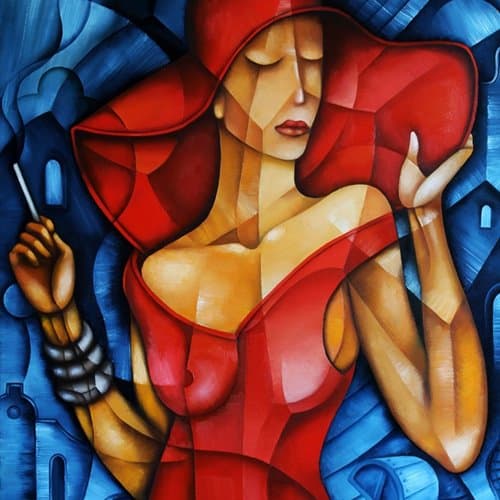
Draconic Mars in 5th House
The Witnessed Performer

With draconic Mars in Leo in the 5th House, your soul was already organized around a specific kind of visibility: the assumption that your creative acts, your romantic moves, your play itself must command attention. This is not a drive toward self-expression that develops over time. This is the baseline. You were born unable to imagine creating anything that does not matter, loving anyone who does not witness you fully, playing a game where you are not the one being watched. The 5th House is where you express yourself most freely, and what you express is intensity as a form of existence.
The trade you made at the soul level is this: you accept the burden of performing at full intensity in every creative and romantic act in exchange for never having to question whether what you make or feel has weight. When you paint, you paint as if someone is watching. When you flirt, you flirt as if you are the only option in the room. When you play with a child or lover, you bring the whole force of yourself. Watch what happens when you create something and no one responds. Notice the small rage. Notice how you either abandon the work or suddenly become more vivid, more extreme, more impossible to ignore. Ordinariness feels like erasure.
You cannot distinguish between being seen and being truly known. You can fill a room with your creative energy, your romantic intensity, your play, and still feel invisible because the attention lands on the performance, not on what you actually want or fear. You may spend years collecting admirers and wake up realizing no one knows your real hesitations, your doubts, what you create when no one is looking. The cost of always being "on" in the 5th House—always the most interesting lover, the most creative presence, the most engaging player—is that intimacy requires you to be less vivid, and being less vivid feels like disappearing entirely. You cycle between needing to be the center of every creative and romantic moment and needing to vanish completely, because the middle ground has never felt safe: being present without dominating, creating without an audience, loving without performing.
What protects this pattern is the conviction that if you stop blazing, you will be forgotten, that your creative work has no value unless it moves someone, that your love has no proof unless it is witnessed. Notice where you cannot simply create alone and feel satisfied. Notice where you are still performing even in private, still lit up, still ready to be seen. The choice is not about dimming your fire. It is about whether you will let yourself make something no one sees and discover it still exists.



























