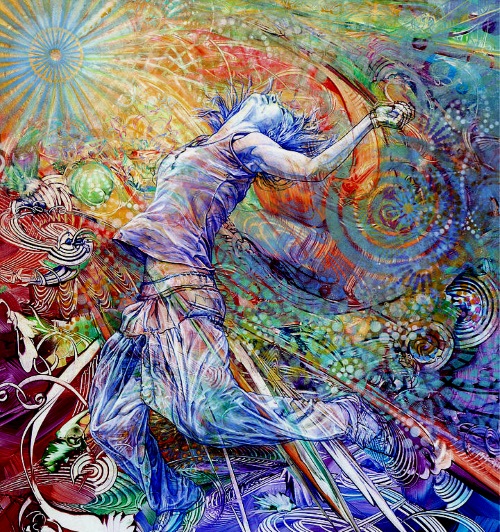
Vertex Conjunct Uranus
Vertex conjunct Uranus creates a particular susceptibility to moments that feel electrically timed, meetings, ruptures, recognitions that arrive with an odd inevitability. The Vertex is a sensitive point where transits and other people's planets trigger relational and directional shifts. Uranus here amplifies the charge: doors open before you knock, and the people or opportunities that appear often carry permission to abandon what no longer fits. The synchronicity is real, but it operates through your own readiness, not external fate.
What you experience is a vulnerability to sudden awakening. When Uranus transits or another person's planet activates this point, you meet something that disrupts your current self-image or trajectory in a way that feels necessary rather than intrusive. A conversation arrives at the exact moment you were questioning your path. Someone reflects back an aspect of yourself you'd hidden. A crisis in one area frees energy for another. You do not cause these moments; you recognize them. The recognition itself is the mechanism, a sudden clarity about what you've been tolerating or postponing. This is not mystical. It is attentional: you notice what others rationalize away.
The pattern that emerges is a tendency to treat every disruption as a signal to leave. You stay in a relationship until the initial charge fades into ordinary partnership, then interpret the flatness as proof it was "not meant to be." You leave a job the moment it stops feeling like discovery and starts demanding depth. You abandon a commitment because the voltage is gone, confusing liberation with avoidance. You say yes to new people and directions with remarkable speed, reading synchronicity as permission rather than invitation. The cost is real: you may resolve the same underlying pattern across multiple relationships, roles, and cities without ever integrating what the disruption was actually trying to teach you.
The actual gift is a finely tuned antenna for inauthenticity. You are less likely than most to spend decades in a life that doesn't belong to you. You act on signals of misalignment rather than rationalize them away. The challenge is learning to distinguish between the call to become more yourself, which requires staying and integrating, and the urge to become someone else entirely, which often looks like liberation but leaves the same pattern unresolved. Not every sudden opening requires you to walk through it. Some of the most important work happens in the friction of staying.