
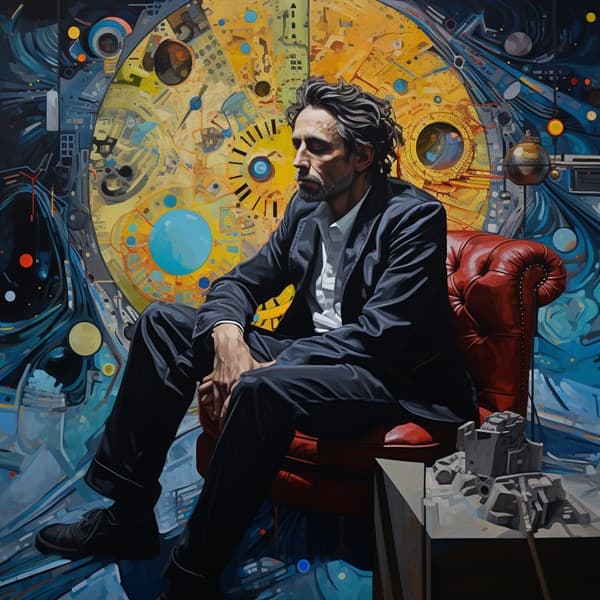
Aquarius 11 Sabian
During a silent hour, a man receives a new inspiration

The central tension here is not between silence and inspiration, but between the promise of transformation and the actual mechanics of how this placement avoids what needs to change. The symbol depicts a man alone, receiving something new. What it diagnoses is the relationship to breakthrough itself: this energy waits for it to arrive clean, untouched by the work of integration. The silence is not peaceful. It is the space where this placement positions itself to receive without having to choose, to be struck by lightning rather than build the circuit itself. This is how the pattern protects the fantasy of change from the friction of change.
Aquarius at degree 11 is not dreaming in the abstract. It is testing ideas against reality, and this man in his silent hour is doing something specific: he is preparing the conditions for an idea to land, then claiming it as grace. This placement may sit with a problem for weeks without moving, then suddenly feel "inspired" to do what was already known to be needed. The inspiration feels like it came from outside. It was not generated through struggle or conversation or trial. This matters because it lets the process skip the part where one is wrong, where one has to revise, where other people push back. The silent hour protects from the collaborative, messy work of actually building something new. The vision is received. Others can implement it. Or they can't. Either way, the purity of the inspiration remains intact.
The failure mode is this: this energy collects moments of clarity but rarely follows through with the mundane steps that make clarity real. There may be an evening spent journaling, emerging convinced of an understanding of relationship dynamics, career direction, or creative path. The understanding feels complete. But understanding is not the same as doing, and the silence that produced it has no accountability built in. A week later, when the work requires showing up tired, or being criticized, or admitting a mistake, the inspiration loses its charge. This pattern protects the experience of knowing from the experience of becoming, and calls this protection "waiting for the right moment."
What is actually being traded away is the slow, iterative, public process of change. The choice is the interior moment of recognition over the exterior moment of failure and adjustment. The man in the silent hour does not have to defend his new idea to anyone. He does not have to watch it fail in small ways and rebuild it. He does not have to be changed by resistance. This trade works until it doesn't: until it becomes clear that all these silently received inspirations have left life structurally identical to how it was. The pattern is not a lack of vision. It is a learned tendency to mistake the feeling of vision for the fact of transformation. Notice where the thinking feels most alive, and notice whether anything outside that thinking has actually shifted.



























