
Cancer 14 Sabian
A group of people who have overeaten and enjoyed it

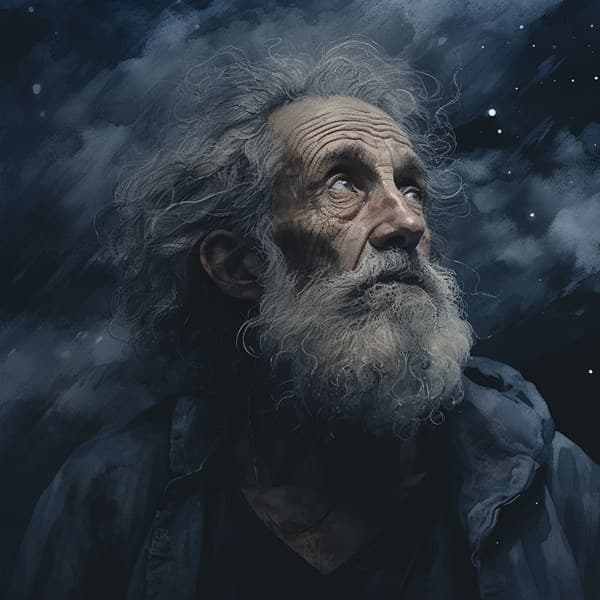
The old man does not turn away from the dark. He faces it directly, and this is not courage—it is a habit so deep it has become invisible. Cancer at the middle degrees is where emotional knowing becomes tested against reality, where feeling must prove itself useful or admit defeat. This man has spent decades learning what cannot be fixed by care, what no amount of nurturing will soften. He stands in the northeast—the direction of clarity and new light—but he looks toward darkness. The contradiction is not accidental. He has learned that the most important things he will ever know arrive from the direction he most wants to avoid.
There is a particular kind of exhaustion in this image. Not the exhaustion of struggle, but of witness. The old man is not fighting the dark space. He is simply looking at it, the way someone looks at a scar they have stopped trying to hide. This is what happens when Cancer's instinct to protect and preserve meets the reality that some things cannot be preserved. You may find yourself becoming the person who can sit with bad news without flinching, who listens to stories others will not hear, who knows exactly how much hope to withhold so that disappointment does not break what remains. You become valuable precisely because you have stopped pretending the dark is not there. But this comes at a cost: you may also become the person who cannot stop looking, who searches for the worst-case scenario the way others search for reassurance, who mistakes vigilance for love.
The trade you have made is this: emotional safety in exchange for the burden of seeing clearly. By accepting that some darkness cannot be transformed, you gain a kind of peace that those still fighting for transformation cannot access. But you also carry the weight of what you have witnessed. You cannot unknow it. When someone comes to you with hope, part of you is already calculating how the hope will break. When you offer comfort, you are comforting from a place that has already grieved. This is not bitterness—it is the particular loneliness of having survived something others are still denying.
The question is not whether you can learn to look away. You cannot, and you would not if you could. The question is whether you can distinguish between what you see and what you must do about it. The dark space to the northeast will not change because you face it. Your facing it does not make you responsible for it. Notice the moment when your clear sight becomes an excuse to stop reaching toward anyone. Notice when you interpret someone else's hope as naivety rather than as a different kind of knowledge. The old man faces the dark, but he is still standing. He has not moved into it. That distinction matters now.



























