Cancer 22 Sabian
A meeting of a literary society

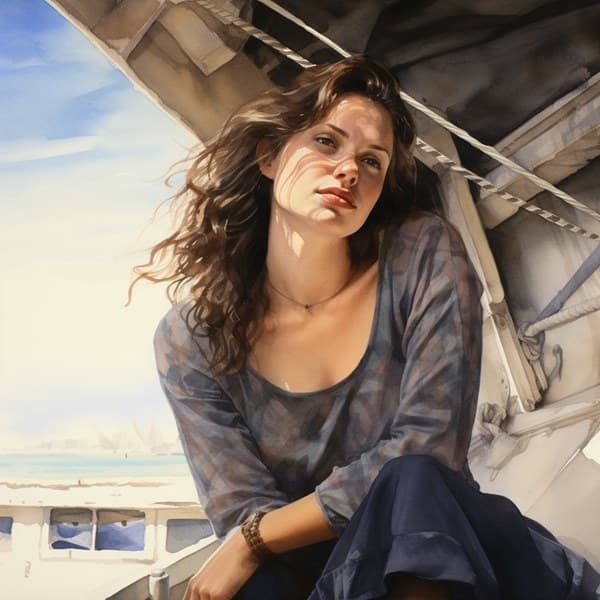
At 22 degrees, Cancer has already moved through the raw vulnerability of early degrees and the testing intimacy of the middle. By now, the sign has learned something hard: that closeness requires waiting. The young woman awaiting a sailboat is not in the thick of emotional life. She is at the shore. She has positioned herself at the threshold between the known (land, safety, the familiar) and the unknown (water, departure, the other). This is not the urgency of early Cancer, which demands immediate fusion. This is late Cancer, which knows that connection requires a kind of patient suspension. She waits. The sailboat has not yet arrived.
What organizes this waiting is not hope alone. The woman has made a choice to be available at a specific place, at a specific time, for a specific person or experience. She has disciplined her openness. She is not wandering the shore in search of boats; she is stationed there, alert but contained. This is the exhaustion of emotional labor that has learned its own limits. You may recognize this in yourself when you find yourself checking your phone at the same time each evening, or keeping a particular chair empty at dinner, or maintaining a certain availability even when the other person has given no clear signal they are coming. The waiting itself becomes the shape of your love. It becomes the only way you know how to hold on without holding too tight.
The failure here is subtle and therefore harder to see. The woman's patience can calcify into a kind of passivity that looks like virtue. She tells herself she is loyal, devoted, trusting. What she may not admit is that waiting protects her from the vulnerability of asking directly, of risking rejection, of moving toward the boat herself. The shore is safe. The boat requires her to leave it. As long as she waits, she cannot fail to arrive; she can only fail to be chosen. The trade is this: she exchanges the risk of active pursuit for the slow ache of conditional presence. She becomes the one who is always ready but never quite the one who decides.
At this late degree, the symbol carries the weight of repetition. She has waited before. The sailboat may have come and gone. She may have gotten in, and the journey may have been less than she imagined, or it may have ended, and she returned to shore. And yet here she is again, in the same posture, at the same threshold. The question is not whether she will keep waiting. The question is whether she can recognize that the waiting itself has become the destination. Notice today whether you are still oriented toward an arrival, or whether you have already arrived at the place where arrival no longer matters. Notice whether the person or experience you are waiting for is real, or whether waiting has become the only way you know to feel connected to something.
The next step is not to stop waiting. The next step is to feel the ground beneath your feet and decide whether you are choosing to stand there, or whether you are afraid to leave.