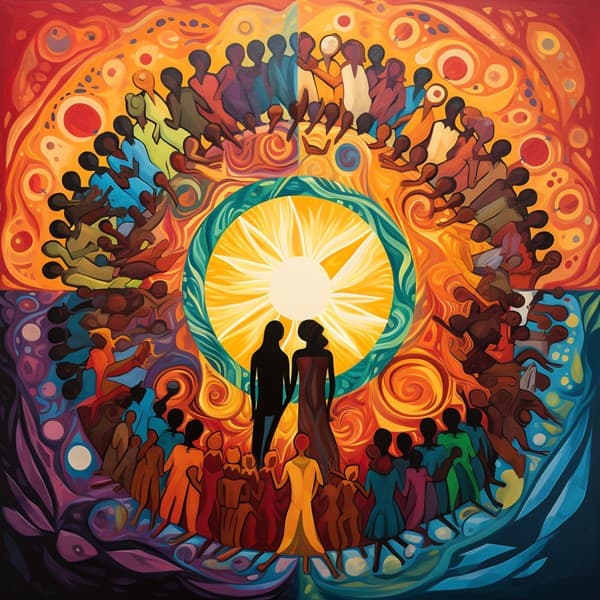
Pluto in 11th House
Transforming your circle of influence

"I am able to lead with humility and empathy, inspiring others through my natural magnetism, while remaining mindful of balance and avoiding a dictatorial attitude."
Pluto in 11th House Opportunities
- Transform through powerful friendships
- Guide others in social welfare
Pluto in 11th House Goals
- Finding balance in high expectations
- Approach with humility and empathy
Pluto in the Eleventh House places you inside a field where group belonging and personal power are inseparable, and often in conflict. The Eleventh House governs friendship, collective participation, ideological alignment, and the groups through which you test your values. Pluto here intensifies everything: your need for substantive connection, your difficulty with surface-level association, your capacity to see through social pretense, and your tendency to reorganize group dynamics around your own psychological necessity.
You do not join groups casually. You enter them as a force, and groups respond, sometimes with magnetism, sometimes with resistance. You perceive the hidden power structures in any circle: who actually decides, who is performing compliance, where the real loyalty lies. This perception is not paranoia; it is accurate. The problem is what you do with it. You may position yourself as the one who will expose or reorganize these structures, believing the group needs your intervention. You move to consolidate influence, to test loyalty, to create conditions where people prove their commitment to you or the cause you champion. You say you want collaboration, but what you are actually building is a circle where your vision dominates and others orbit around it.
The blindness here is mistaking intensity for intimacy, and mistaking the group's willingness to follow your lead for genuine agreement. You attract people who admire your conviction and your refusal to settle for mediocrity, but over time, they often experience you as controlling, as someone who redefines friendship on terms that serve your transformation, not theirs. You may cycle through friendships and group memberships, each time convinced the last group was compromised or shallow, each time reorganizing the new one around your deeper vision. What actually happens is that you leave a trail of people who felt used or dominated, even if you never intended harm. Your loyalty is real, but it is conditional on others accepting your framework.
The developmental work is learning that groups do not exist to facilitate your evolution. They exist as separate entities with their own integrity. This means tolerating ideological difference without needing to convert or eliminate it. It means accepting that you cannot see everything, that your perception of hidden power dynamics is not always accurate, and that sometimes people are simply tired rather than disloyal. Friendship in this placement matures when you can be powerful without needing to reorganize, when you can hold strong convictions without requiring the group to validate them, and when you can leave a circle without needing to burn it down first.