Aries 11 Sabian
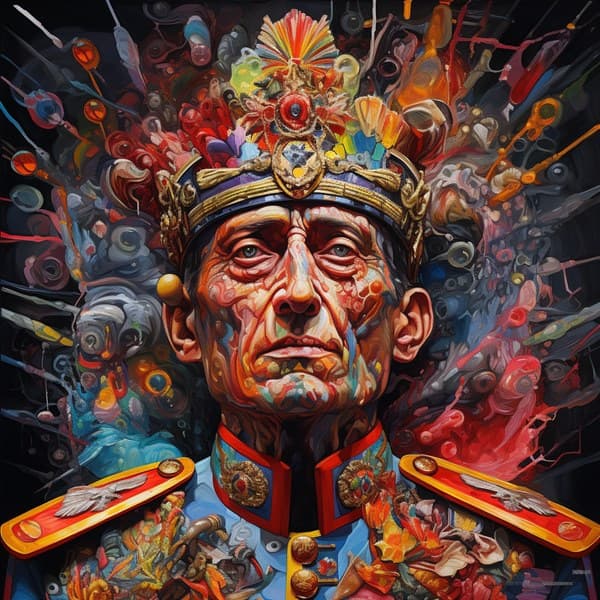
The president of the country

The president sits in the seat of power, and the first thing to notice is that the seat itself is the only thing that matters. This is not a person who earned authority through some internal transformation; this is a person who occupies a position that confers authority the moment the body settles into it. The office makes the president, not the reverse. At Aries 11, you are in the middle of testing whether you have what it takes to hold a role that demands constant performance of certainty, and the symbol shows you the mechanism: the role does half the work. You walk into the room and people listen. You speak and people obey. The structure itself carries you. But this is also the trap. The presidency in this image is a function, not a self. It requires that you never admit doubt, never show the machinery, never step outside the frame where the authority still holds. You are not free inside this seat. You are bound to it.
Notice that a president must always be performing the role, even in private, because the role has no off switch. The moment you stop acting like a president, you are no longer one—not because the title disappears, but because authority is not a thing you possess, it is a thing you enact. This means you are always onstage, always watched, always responsible for maintaining the illusion that you know what you are doing. You may find yourself unable to admit confusion to anyone, because the structure requires that you project absolute direction. You text your team with commands when you are actually terrified. You make decisions quickly not because you are certain but because hesitation reads as weakness. The president cannot say "I don't know." The role will not allow it. So you learn to perform certainty so well that you forget it is a performance.
The deeper cost is that power obtained through position rather than through genuine authority creates a constant low-level panic. You are always one mistake away from exposure. The seat can be taken. The role can be lost. Someone younger, smarter, more ruthless can challenge you, and then the structure that was carrying you will carry them instead. This is why the president in this image must be vigilant, controlling, unwilling to delegate or trust. The authority is not yours; it is borrowed from the office. You must protect the office because if the office falls, you disappear. You may notice this in yourself as an inability to let anyone see the real workings of your decisions, a need to appear seamless and invulnerable, a constant calculation of who might be positioning themselves to replace you. The presidency teaches paranoia. It teaches you that the people who smile at you are also measuring your weakness.
What the symbol does not show is what happens when the president leaves the office. The authority vanishes instantly. There is no residual power, no internal resource that survives the loss of the seat. This is the trade you have made: immediate authority in exchange for the knowledge that you are fundamentally dependent on a structure you do not control. At Aries 11, you are testing whether you can live with this bargain. You are learning what it costs to have people follow you not because they believe in you but because they have to. The question is not whether you can hold the seat. The question is whether you can live inside it without losing yourself completely. Right now, you are still performing too perfectly. Notice where you cannot afford to be uncertain, where you must always know the answer, where you are more invested in the image of leadership than in the actual work.
The next move is not to abandon the role or to refuse the power. It is to recognize that the authority the seat gives you is real, but it is also fragile, and fragility is not weakness—it is the truth. You can lead from the seat and still admit what you do not know. You can make decisions and still be uncertain. You can hold power and still be human. The president who can do this is more dangerous than the one who must perform invulnerability, because he is not afraid of being exposed. He is already exposed. But this requires that you stop needing the seat to tell you who you are.