Aries 18 Sabian
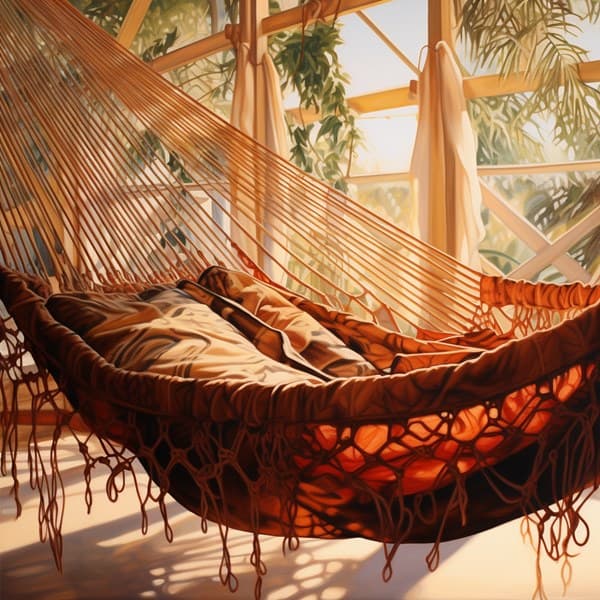
An empty hammock

The hammock is empty. This is the first fact, and it carries all the weight. In Aries, the sign of initiation and direct action, you are presented not with a call to move but with the evidence of movement already abandoned. The hammock exists to receive a body, to hold weight, to be occupied. Instead it hangs suspended between two points, waiting. This is not rest. Rest requires someone in it. What you are looking at is the shape of rest without the person who would claim it, and that absence is the organizing principle: you know how to create the conditions for rest, for pause, for strategic withdrawal, but the moment those conditions exist, something in you refuses to settle into them.
The tension is not between action and rest. It is between the impulse to prepare for rest and the inability to actually rest once the preparation is complete. You build the hammock. You tie it carefully between the two trees. You test it with your hand. And then you walk away. In the middle degrees of Aries, you are not raw and untested; you are experienced enough to know exactly what you are doing when you do this. You are not confused about what the hammock is for. You are deliberately choosing the empty space over the occupied one. This choice has a name: it is called staying ready. The hammock represents the luxury you have earned the right to take, and your refusal of it is your way of proving you have not softened, that you are still capable, still sharp, still willing to move. The moment you lie down in it, something inside you registers as weakness.
Notice where you create elaborate systems of self-care you never use. The meditation app you paid for. The morning routine you researched and assembled. The boundary you announced but do not enforce because enforcing it would mean actually stepping back from the work. The hammock is there. It is ready. You could use it right now. But using it would require admitting that you need it, and in Aries at 18 degrees, that admission feels like surrender. You have built competence through constant forward motion, and rest reads to you as the first sign that the motion will stop permanently. So you keep the hammock empty as proof that you could rest anytime you wanted to. You just do not want to. Not yet. Not while there is still something to prove.
The cost of this pattern is not dramatic. It is slow. The hammock does not judge you for walking past it. It simply remains empty, a permanent fixture of your landscape, a thing you have to see every time you move through that space. You have organized your life so that rest is always available and always refused, and this gives you a particular kind of exhaustion: not the exhaustion of someone who has no choice, but the exhaustion of someone who has made a choice and keeps making it again every single day. The question is not whether you deserve the hammock. You do. The question is what you are protecting by staying out of it. What would happen if you stopped moving? What would you have to feel? What would you have to know about yourself?