Gemini 30 Sabian
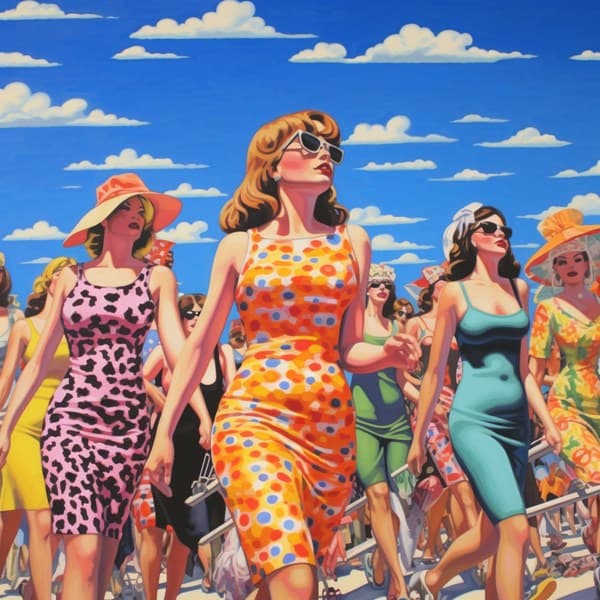
Bathing beauties

At the final degree of Gemini, the parade has already happened many times. The bathing beauties are no longer a surprise; they are a known commodity, a performance that everyone expects and no one quite believes in. This is not the thrill of display but the exhaustion of it. The central tension is between the compulsion to keep performing visibility and the hollowing out that happens when visibility becomes routine. You have learned to turn yourself into a spectacle, and now you cannot stop, even though the audience's gaze no longer touches you the way it once did. The crowds remain large. Your skill at arranging yourself, at knowing exactly which angle catches light, is flawless. But something has drained from the act itself.
At this late degree, you recognize the machinery. You see how the parade works: the timing of the reveal, the rhythm of the crowd's attention, the precise moment when interest peaks and begins to wane. You have internalized the formula so completely that you can execute it without presence. You show up, you perform connection, you gather attention—and part of you watches from outside, taking notes. This split between the one who performs and the one who observes is not new, but at degree 30 it has calcified into a kind of professional distance. You may scroll through your own social media with the detachment of a critic reviewing someone else's work. You know what will land. You do it anyway. The competence is undeniable; the meaning has evaporated.
The failure of this pattern is not that you cannot attract attention. It is that you have confused visibility with being seen. The crowds are large, but they are not looking at you; they are looking at the role you have perfected. You have become so skilled at giving people what they want to see that you have forgotten what it feels like to be perceived as yourself rather than as a curated version of yourself. The trade you have made is this: you exchanged the vulnerability of being unknown for the safety of being known as a performance. Now that safety feels like a cage you built yourself, and you are too practiced at the role to simply step out of it.
What matters now is whether you can tolerate being less interesting. Not less visible—less polished, less on-message, less designed for consumption. The parade will continue with or without your perfect execution. The crowds will remain. The real question is whether you are willing to disappoint them, to show up as someone who is not always camera-ready, to let the performance falter so that something actual might have a chance to emerge. Notice where you reach for the familiar gesture, the tested line, the angle that always works. That instinct is not wrong. It is just exhausted.
The next choice is not to perform better or to withdraw entirely. It is to perform less deliberately. To let yourself be awkward in front of the crowd. To say something you have not rehearsed. The bathing beauties in the parade are interchangeable precisely because they are perfect. You are not interchangeable. What you are protecting by staying in formation is the possibility that if you step out, no one will look. Test that assumption. The crowds may surprise you.