Taurus 27 Sabian
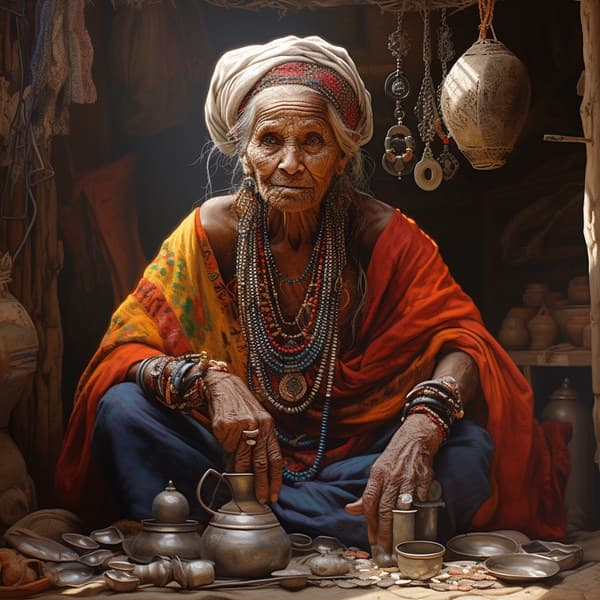
A Squaw selling beads

This symbol sits at the threshold of Taurus, where material exchange has become ritual rather than transaction. The old Indian woman is not building wealth or securing her future. She is repeating a gesture so worn into her body that the beads themselves have become secondary to the act of offering. At 27 degrees, you are not learning the value of things. You are learning what it costs to keep valuing them. The central tension is between the persistence required to survive and the awareness that survival alone has become the entire story. She shows up. She sells beads. The repetition is both her anchor and her cage.
What makes this symbol difficult is that it disguises resignation as wisdom. You may find yourself describing your routines as "grounded" or "authentic," when what you are actually doing is managing decline by making it sacred. The woman's age is not incidental. It suggests decades of the same small transaction, the same corner, the same hands exchanging currency for color. You recognize value in this steadiness—and there is real value in it—but the symbol reveals something harder: you may stay in a pattern not because it nourishes you, but because leaving it would require admitting that the years spent perfecting it were not the point. Notice where you defend your limitations as choices. Notice where you tell the story of your own persistence to avoid the story of your own stagnation.
The beads themselves are diagnostic. They are beautiful, portable, useless for survival, and endlessly reproducible. In Taurus, they represent the comfort of small, tangible things that require no growth to maintain. You may organize your life around producing or preserving or selling these beads—literal or metaphorical—because they are knowable. They do not demand that you become someone new. They do not require risk. But at degree 27, the question is no longer whether the beads are good. The question is whether you have mistaken the beads for a life. The woman's wrinkles are not a reward for loyalty. They are the mark of time spent in a single posture.
What protects you in this pattern is the trade you have made: security for expansion, predictability for aliveness. You do not have to wonder if you are enough, because the beads have already defined what enough means. You do not have to risk failure, because you have already succeeded at this one small thing so many times that failure feels impossible. The cost is that you may wake one day and realize you have been waiting for permission to stop, and no one is coming to give it. The beads will still be there. The corner will still be there. But you will be older. The question is not whether to keep selling them. The question is whether you are still choosing to, or whether you have simply forgotten how to choose anything else. What matters now is noticing the difference between those two states.
The next step is not more intensity or more beads or a better corner. The next step is asking yourself what you would do if the beads were already sold, if the transaction was already complete, if you were already free. Stay with that question long enough to feel uncomfortable. That discomfort is where you will find what you actually want, beneath the weight of what you have learned to call enough.