
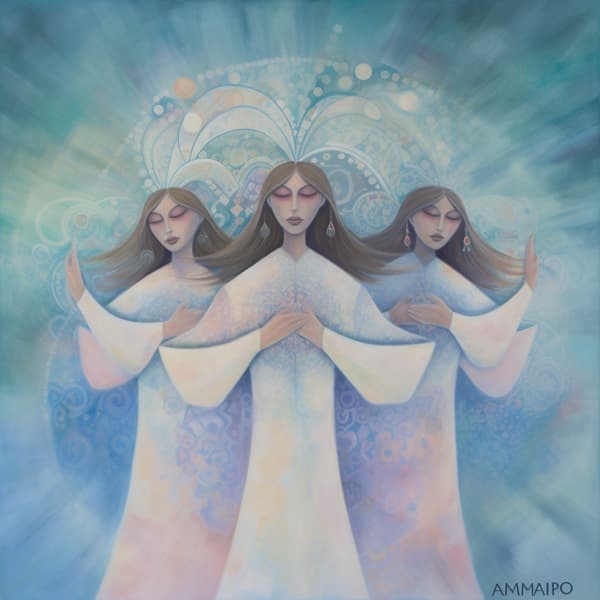
Chiron Conjunct Neptune
Healer's Permeability


"I am a healer, tapping into my intuitive gifts, finding balance in offering support while prioritizing self-care, embracing my own healing journey to inspire and guide others."
Chiron Conjunct Neptune Opportunities
- Exploring your own wounds
- Bringing healing to others
Chiron Conjunct Neptune Goals
- Navigating illusion and reality
- Finding balance in pain
Chiron conjunct Neptune fuses the wound-healer archetype with the dissolution of boundaries. You carry an unusual permeability, not weakness, but a nervous system tuned to frequencies others miss. Where Chiron holds the capacity to transform pain into teaching, Neptune dissolves the membrane between self and other, between the personal wound and the collective one. This conjunction makes you a kind of psychic antenna for suffering you didn't originate.
Your empathy operates at the level of resonance, not just recognition. You don't primarily understand others' pain through analysis or even emotional mirroring, you feel it as a direct transmission, as though their unhealed material has a gravitational pull on your own nervous system. This can make you genuinely helpful to people in crisis or deep confusion, because you meet them in the fog rather than from solid ground. But this same permeability means you often cannot distinguish between what is yours to heal and what belongs to the person in front of you. You absorb the shape of their wound and begin treating it as your own, which creates a particular kind of exhaustion: not the tiredness of effort, but the disorientation of losing track of your own outline.
The blind spot here is not that you lack boundaries, it's that you may mistake the dissolution of boundaries for spiritual depth or compassionate attunement. Clarity is not coldness. The moment you can name what you are feeling as theirs rather than yours, you regain the capacity to actually help without disappearing into the work. Neptune without grounding tends toward diffusion; Chiron without clarity tends toward over-identification with the wound. When you learn to hold both, to feel the collective pain without merging into it, you become something more precise than a sponge: you become a translator. You can move between the wounded place and the world, carrying meaning without carrying the whole weight.



























